Recycling and Sustainability for Commercial Waste Mortlake
Welcome to our overview of sustainable waste services for Commercial Waste Mortlake. This page outlines how businesses in Mortlake and nearby boroughs can access an eco-friendly waste disposal area and benefit from schemes that reduce landfill, cut carbon and support local reuse. We present targets, practical steps, and the local partnerships that make a low-impact Mortlake commercial waste service possible.Ambitious recycling percentage target
Our primary aim is to lift recycling performance across the commercial sector. We have set a clear target: 70% recycling of commercial waste by 2030. This target aligns with broader borough ambitions for waste separation and improved resource recovery. Achieving this depends on accurate segregation at source, better bin labelling, and regular waste audits for shops, offices and light industrial sites in Mortlake.
Low-carbon fleet and route optimisation
We operate a modern, low-emission fleet for Mortlake commercial waste collections. Our low-carbon vans include electric and hybrid vehicles combined with optimised routing software to minimise mileage and emissions. The move to a low-carbon collection fleet is a core part of creating a truly sustainable rubbish area where transport-related emissions are reduced alongside higher recycling rates.Local transfer stations and recycling centres
Businesses can use local transfer stations and borough recycling centres to dispose of segregated materials. These facilities accept segregated streams and consolidate them for onward processing, improving diversion from landfill. The proximity of transfer stations and mixed-commercial recycling hubs in west London supports efficient handling of glass, cardboard, wood and non-hazardous construction waste from Mortlake sites.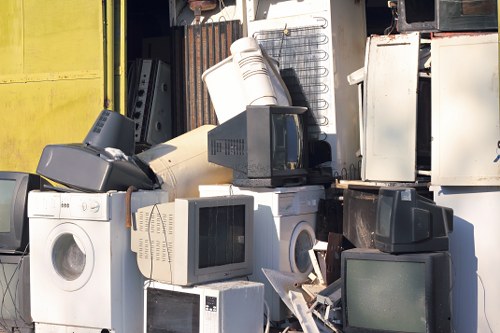
Partnerships with charities and reuse organisations
We actively partner with local charities and reuse groups to keep valuable items in circulation. Usable office furniture, IT equipment and fixtures are audited for reuse and offered to community groups before recycling. Food-related waste streams from cafés and catering within Mortlake are routed through redistribution partners where safe and appropriate, reducing food waste while supporting local food aid initiatives. These charity partnerships are central to building a circular, community-focused commercial waste network.To support separation at source the boroughs approach to waste separation is reflected in our services: businesses are encouraged to separate paper, cardboard, glass, metal, plastic and food waste into dedicated containers. We provide clear labels, training sessions, and regular checks so that recyclable material is not contaminated and can be processed efficiently at the transfer station.
What recyclable activity looks like in Mortlake
Commercial recycling activity in the area includes:- Paper & cardboard baled and sent for pulping and remanufacture.
- Glass, tins and plastics sorted for reprocessing.
- Food waste collected separately for anaerobic digestion to produce energy and soil conditioners.
- WEEE and small electronic items directed to certified treatment centres for parts recovery.
How we measure progress and report impact
Progress is tracked through tonnage-based reporting and monthly performance reviews. Recycling rates are calculated from audited weights at transfer stations, adjusted for contamination rates. We publish anonymised performance summaries for participating commercial clients so that the collective impact in Mortlake is visible: reduced residual waste, increased reuse via charity partners, and measurable CO2 savings from our low-carbon vans. Our fleet conversion and route efficiency aim to cut collection-related emissions by at least 35% compared with a conventional diesel baseline.
Creating a sustainable rubbish area: practical steps for businesses
Businesses can help create a more sustainable rubbish area by committing to simple actions:
- Segregate waste at source using the borough-style multi-stream approach.
- Request regular collections for separated streams to avoid contamination.
- Donate or reuse functional furniture and equipment through our charity partners.
- Engage staff with short training and clear signage to maintain high-quality recyclables.
By adopting these practices, Mortlake commercial waste generators contribute to the local circular economy, support community reuse initiatives and help us meet the 70% recycling target. Our combined approach — local transfer stations, charity partnerships, a low-carbon van fleet and borough-aligned separation systems — creates a resilient and efficient eco-friendly waste disposal area for businesses of all sizes.
